Here is a comprehensive course description for Fashion Design and Clothing Technology.
This overview covers the typical curriculum, skills acquired, and career paths for a standard Diploma or Degree program in this field.
Course Overview: Fashion Design and Clothing Technology
Fashion Design and Clothing Technology is an intensive program that bridges the gap between creative fashion concepts and the technical manufacturing processes required to bring those designs to life.
While "Fashion Design" focuses on aesthetics, trends, and the creative vision, "Clothing Technology" grounds that vision in reality by teaching students how garments are actually constructed, mass-produced, and quality-controlled. The course is designed to produce holistic professionals who can sketch a design, draft the pattern, select the right textiles, and oversee its production from the sewing machine to the retail floor.
Course Objective: To equip students with the creative, technical, and entrepreneurial skills necessary to succeed in the dynamic, fast-paced global fashion and apparel manufacturing industry.
Core Learning Modules
The curriculum is typically divided into three main pillars: Creative Design, Technical Production, and Fashion Business.
-
1. Design & Illustration
-
Fashion Sketching & Illustration: Learning to draw the fashion figure (croquis) and communicate design ideas visually.
-
Color Theory & Design Principles: Understanding how color, texture, and silhouette impact garment aesthetics.
-
Computer-Aided Design (CAD): Using software like Adobe Illustrator or specialized fashion software to create digital flats and 3D garment models.
-
History of Fashion: Studying historical trends to inspire modern collections.
-
-
2. Clothing Technology & Production
-
Textile Science: Understanding the properties of different fibers, yarns, and fabrics, and how they behave when cut, sewn, and worn.
-
Pattern Drafting & Grading: Learning to create flat paper patterns based on body measurements and scaling them for different sizes.
-
Garment Construction: Mastering industrial sewing techniques, draping on a mannequin, and assembling different types of clothing (tailoring, casual wear, couture).
-
Quality Control & Assurance: Ensuring garments meet industry standards for durability, fit, and finish.
-
-
3. Fashion Business & Management
-
Apparel Merchandising: Understanding retail, pricing strategies, and getting garments from the factory to the store.
-
Fashion Forecasting: Analyzing market trends to predict what consumers will want to wear in the future.
-
Entrepreneurship: Learning how to start, brand, and run an independent fashion label or boutique.
-
Key Skills Acquired
-
Technical Proficiency: Ability to operate industrial sewing machines and specialized production equipment.
-
Precision and Accuracy: High-level skills in taking measurements, cutting fabric, and drafting precise patterns.
-
Creative Problem Solving: Figuring out how to translate a complex, imaginative sketch into a wearable, structurally sound piece of clothing.
-
Business Acumen: Understanding costings, profit margins, and marketing within the apparel sector.
Career Opportunities
Graduates of this course have a wide array of career paths available to them, ranging from creative roles to factory management:
-
Fashion Designer: Creating original clothing, accessories, or footwear.
-
Pattern Maker / Cutter: Translating a designer's sketch into a technical blueprint.
-
Garment Technologist: Choosing the right fabrics and ensuring garments are made efficiently and safely.
-
Quality Assurance Manager: Overseeing the standard of mass-produced apparel in a factory setting.
-
Fashion Merchandiser / Buyer: Selecting and buying clothing for retail stores.
-
Costume Designer: Designing wardrobes for film, television, or theater.
-
Fashion Entrepreneur: Launching and managing an independent clothing brand.
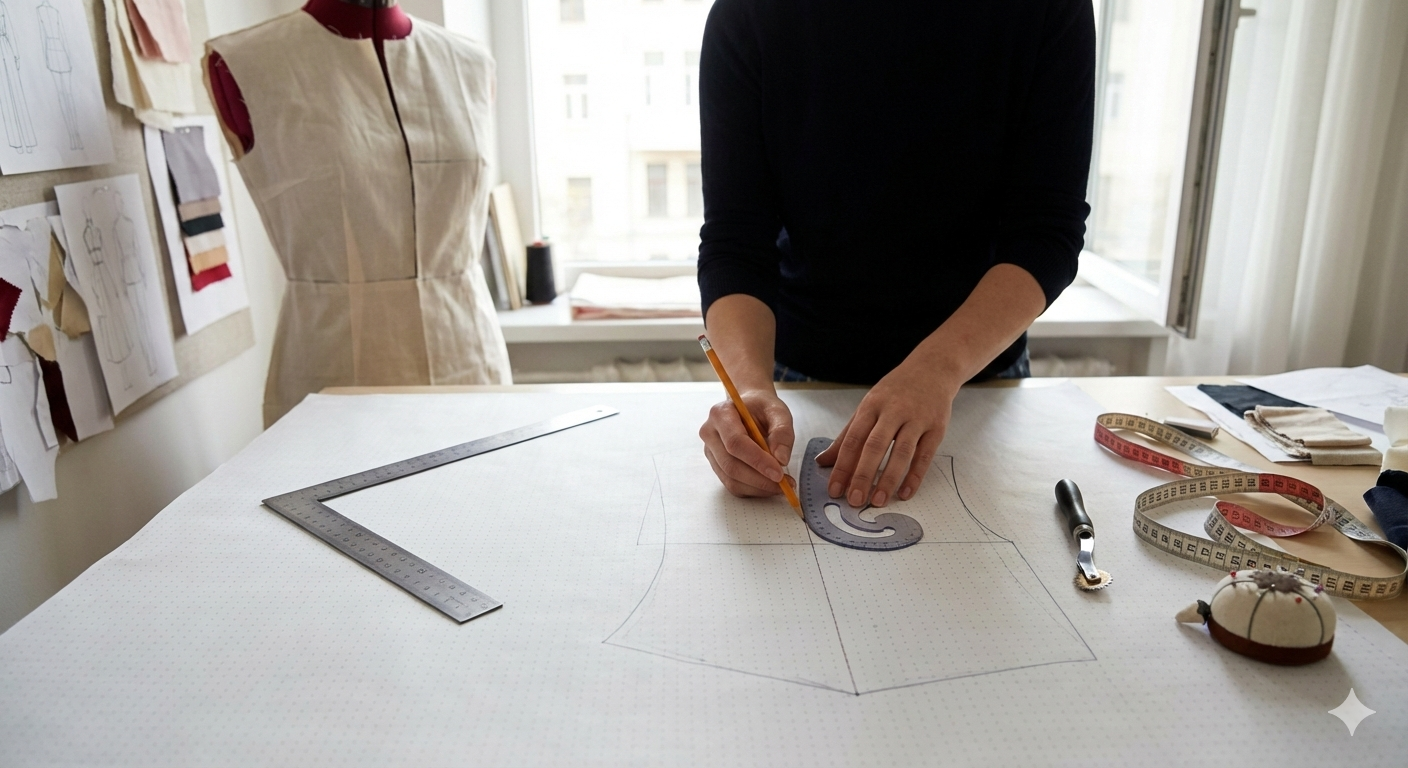
Course Title: Pattern Drafting for Fashion Design
Course Level: Beginner to Intermediate
Prerequisites: Basic understanding of sewing is helpful, but not required.
Course Overview
Pattern drafting is the foundational bridge between a fashion illustration and a wearable, 3D garment. This course introduces students to the principles of flat pattern making, teaching them how to translate their creative designs into precise paper templates. Students will learn how to take accurate body measurements, draft fundamental "slopers" (basic blocks), and manipulate these blocks to create a wide variety of original, customized garment designs.
Learning Objectives
By the end of this course, students will be able to:
-
Accurately measure the human body for custom-fit garments.
-
Draft the five basic foundational blocks: bodice front, bodice back, skirt front, skirt back, and sleeve.
-
Apply various dart manipulation techniques (slash-and-spread and pivotal transfer) to move fullness and create new silhouettes.
-
Draft secondary pattern pieces including collars, facings, waistbands, and cuffs.
-
Add seam allowances, notches, and grainlines to finalize production-ready patterns.
-
Identify and correct common fit issues.
Core Modules & Topics
Module 1: Introduction to Tools and Measurements
-
Understanding the pattern drafter's toolkit (French curve, hip curve, L-square, awl, tracing wheel, notcher).
-
Terminology and symbols used in the fashion industry (grainlines, cut-on-fold, notches, drill holes).
-
The anatomy of the body and how to take precise, professional measurements.
Module 2: Drafting the Basic Blocks (Slopers)
-
Drafting the basic straight skirt block.
-
Drafting the basic bodice block (front and back).
-
Drafting the basic fitted sleeve block.
-
Creating a mock-up (toile/muslin) to test the fit of the blocks.
Module 3: Dart Manipulation
-
Understanding the pivot point (bust apex) and dart equivalence.
-
The Slash and Spread method: Cutting the pattern to move darts to new locations (e.g., French dart, neckline dart).
-
The Pivotal Transfer method: Shifting darts without cutting the paper.
-
Converting darts into gathers, pleats, and tucks.
Module 4: Stylelines and Silhouettes
-
Drafting princess seams (armhole and shoulder).
-
Adding fullness: A-line skirts, flared skirts, and circle skirts.
-
Creating yokes for skirts and bodices.
Module 5: Necklines, Collars, and Sleeves
-
Modifying necklines (V-neck, scoop, boat neck).
-
Drafting flat collars (Peter Pan, sailor) and stand collars (Mandarin, shirt collar).
-
Sleeve variations: Puff sleeves, bell sleeves, cap sleeves, and bishop sleeves.
Module 6: Finalizing the Pattern
-
Drafting facings and linings for clean finishes.
-
Trueing seams (ensuring adjoining seam lengths match perfectly).
-
Adding industry-standard seam allowances and hem allowances.
Who is this course for?
-
Fashion Design Students looking to build a strong technical foundation.
-
Home Sewists who want to break free from commercial patterns and design their own clothes.
-
Aspiring Independent Designers who need to create custom fits for clients.
- Teacher: wagaya mouline